There is an assumption so deeply embedded in modern culture that most people do not even recognize it as an assumption. It goes like this: consciousness is something the brain does. Neurons fire, chemicals flow, electrical patterns dance across the cortex, and out of this impossibly complex biological machinery, awareness arises. You see red. You feel love. You know you exist. All of it — every flicker of experience — is produced by three pounds of grey matter inside your skull.
This assumption feels obvious. It feels scientific. It feels like settled fact.
It is none of these things. It is a philosophical position — a metaphysical commitment — that has never been proven, that faces devastating objections, and that the most honest neuroscientists and philosophers of mind will tell you remains one of the deepest unsolved problems in all of science.
Let us look at what we actually know, what we are assuming, and what a tradition thousands of years older than neuroscience has to say about the matter.
What Neuroscience Has Actually Established
Neuroscience has established, beyond any reasonable doubt, that there is a correlation between brain activity and conscious experience. Damage to specific brain regions produces specific deficits in experience — damage to the visual cortex impairs vision, damage to the hippocampus impairs memory, damage to the prefrontal cortex alters personality and judgment. Stimulating certain brain regions electrically can produce vivid experiences — flashes of light, emotional surges, even memories.
These correlations are real, reproducible, and important. They are also exactly what you would expect if the brain were producing consciousness. But — and this is the point that is almost always glossed over — they are also exactly what you would expect if the brain were filtering, channelling, or transmitting consciousness rather than producing it.
Consider a television set. If you damage a television's components, the picture degrades. If you destroy the television, the picture disappears. But this does not mean the television is producing the broadcast signal. The signal exists independently of any particular receiving device. The television is an instrument through which the signal is received and converted into a form that can be experienced in a particular location.
This analogy is imperfect, as all analogies are. But it illustrates a crucial logical point: correlation between brain activity and conscious experience does not establish that the brain generates consciousness. It is equally consistent with the hypothesis that the brain mediates consciousness — that awareness is a fundamental feature of reality that the brain focuses, shapes, and channels into the particular stream of experience that constitutes an individual mind.
The Hard Problem
In 1995, the philosopher David Chalmers gave a name to the difficulty that had been quietly embarrassing materialist philosophy for decades: the Hard Problem of Consciousness.
The easy problems of consciousness — and Chalmers was careful to note that they are "easy" only by comparison — are questions about how the brain processes information, discriminates between stimuli, integrates data, produces reports, and controls behaviour. These are engineering problems, and neuroscience is making steady progress on them.
The Hard Problem is different. It asks: why is there subjective experience at all? Why does the processing of information feel like something? When you see the colour red, there is a particular quality to the experience — a "what it is like" to see red — that seems utterly different from anything that can be captured by a description of neuronal firing patterns. You could, in principle, map every neuron involved in seeing red, trace every chemical cascade, model every electrical potential — and you would still not have explained why that particular pattern of physical activity is accompanied by the subjective experience of redness.
This is not a gap that more data will fill. It is a conceptual chasm. Physical descriptions operate in the language of quantities — mass, charge, frequency, spatial position. Conscious experience operates in the language of qualities — colour, pain, joy, the taste of coffee. How does one arise from the other? What is the bridge? Neuroscience does not have an answer. More precisely: neuroscience does not even have a framework in which the answer could appear, because its methodology is designed to study third-person, objective phenomena, and consciousness is, by its very nature, a first-person, subjective phenomenon.
This is not a failure of neuroscience. It is an indication that consciousness may not be the kind of thing that can be explained by a physical science — not because it is supernatural, but because it may be more fundamental than the physical, not less.
The Vedāntic Position
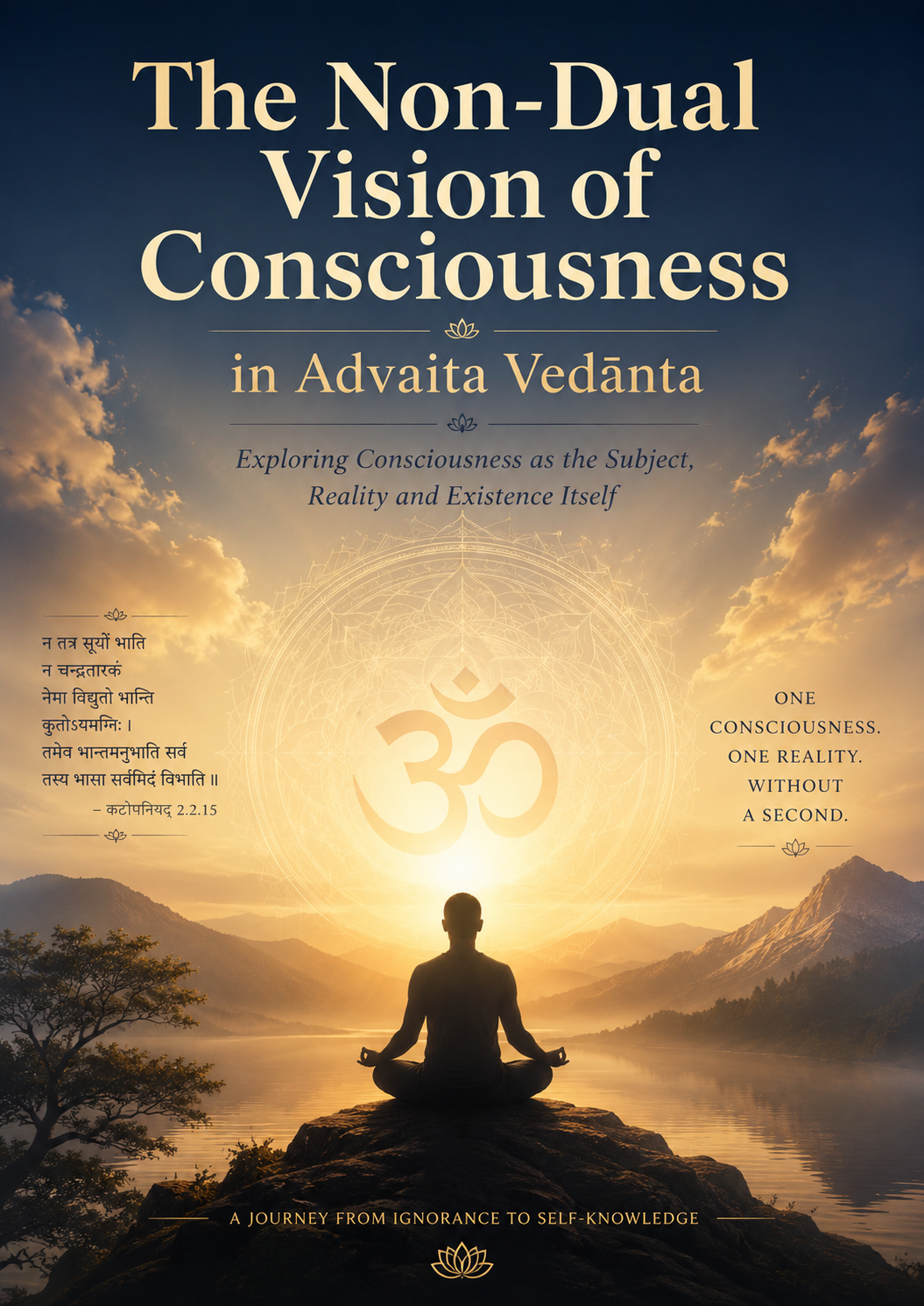
The Vedāntic answer to the question "is consciousness produced by the brain?" is a clear, unequivocal no. Consciousness is not produced by anything. It is not an emergent property of complex matter. It is not the result of computation. It is the irreducible ground of all existence — what the Upaniṣads call Brahman, and what Śaṅkara identifies as Sat-Chit-Ānanda: existence, consciousness, and fullness.
In Advaita Vedānta, consciousness is not one thing among many. It is the only thing. Matter, energy, space, time — all of these appear in consciousness, not the other way around. The brain is an object that appears in awareness. Awareness does not appear in the brain. This is not a theoretical claim; it is an invitation to direct investigation. Right now, as you read this, you are aware. Where is that awareness located? Can you find its edges? Can you point to the place where it begins or ends? Can you observe it the way you observe an object?
You cannot — because awareness is not an object. It is the subject. It is the very capacity by which objects are known. And a capacity for knowing cannot itself be known as an object, any more than an eye can see itself or a fire can burn itself.
The Vedāntic tradition draws a clear distinction between consciousness (cit) and the mind (manas/buddhi). The mind is an instrument — a subtle material apparatus composed of the guṇas of prakṛti — that processes, organizes, and presents experience. The brain is the gross physical correlate of this subtle instrument. Consciousness is the light that illuminates the mind's contents. Without consciousness, the mind is inert — a camera without light, a screen without power. Without the mind, consciousness does not cease to exist; it simply rests in its own nature, as it does in deep sleep.
This framework resolves the Hard Problem elegantly. There is no need to explain how consciousness arises from matter, because it does not. Consciousness is primary. Matter is a modification that appears within consciousness, the way waves appear within the ocean. The relationship is not causal (matter produces consciousness) but ontological (consciousness is the being in which matter appears).
Objections and Responses
"If consciousness is not produced by the brain, why does brain damage affect consciousness?"
Because the brain is the instrument through which consciousness is channelled into a particular stream of individual experience. Damage the instrument, and the stream is distorted — just as a cracked lens distorts the light passing through it without affecting the light itself. In deep sleep, when the brain's information-processing activity is at its minimum, consciousness does not disappear — it rests in a formless, objectless state from which the individual wakes up and reports having existed.
"If consciousness is fundamental, why can't we detect it with our instruments?"
Because our instruments are designed to detect objective, measurable phenomena — electromagnetic fields, chemical concentrations, electrical potentials. Consciousness is not an objective phenomenon. It is the subjective ground in which all objective phenomena appear. Asking "where is the consciousness?" in a brain scan is like asking "where is the seeing?" in an eye examination. The seeing is not in the retina. It is what the retina serves.
"Isn't this just 'God of the gaps' reasoning — inserting a mystical explanation where science hasn't yet found a physical one?"
No, for two reasons. First, the Hard Problem is not merely an unsolved puzzle awaiting a physical answer. It is a category problem — the difficulty of deriving first-person subjective experience from third-person objective descriptions — and category problems are not solved by collecting more data within the existing category. Second, the Vedāntic position does not invoke anything supernatural. It proposes that consciousness is natural — more natural than matter, in fact — and that our assumption of matter's primacy is itself the mistake.
Why This Matters
This is not merely an academic debate. The question of whether consciousness is primary or derivative shapes everything — your relationship to your own mind, your understanding of death, your ethical framework, your sense of meaning.
If consciousness is produced by the brain, then you are fundamentally a biological machine. Your experiences, your loves, your insights, your sense of beauty — all of it is neural computation and nothing more. When the machine breaks down, you are gone. Meaning is a useful fiction. Ethics is a social contract. The universe is, at bottom, dead matter that has temporarily arranged itself into patterns complex enough to hallucinate that they are aware.
If consciousness is fundamental, then the picture reverses entirely. You are not a body that happens to be conscious. You are consciousness that happens to be expressing itself through a body. The body is an instrument, extraordinary and precious, but not the totality of what you are. Death is not annihilation but a change of instrument. The universe is not dead matter that produces mind but living awareness that takes the form of matter. And the sense of meaning that pervades human experience is not a hallucination — it is a glimpse of the nature of reality itself.
Vedānta does not ask you to believe this on faith. It asks you to investigate. Look at your own experience. Is awareness something you do, or something you are? Is it produced by the brain, or is the brain known by it? These are not questions that require a laboratory. They require only the willingness to look — honestly, carefully, and without the assumption that the answer must be physical.
The eye that sees everything cannot see itself. But it can know that it sees. And in that knowing, the entire question is resolved.
This article is part of the Vedanta and Consciousness series at Vedhian.com. The Vedāntic position on consciousness is developed extensively in the Māṇḍūkya Upaniṣad, the Vivekacūḍāmaṇi, and Śaṅkara's Upadeśa Sāhasrī.