ज्ञान
The Knowledge Vault
A living, ever-expanding sacred library — Vedic wisdom for the modern seeker. New articles added regularly.
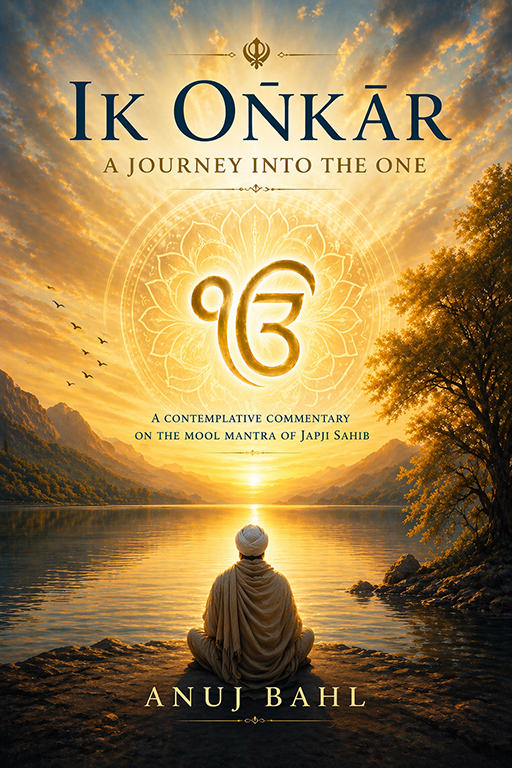
📌IK ONkar: A JOURNEY INTO THE ONE
There are moments in life when a human being suddenly feels that something essential is missing—not materially, but existentially. One may possess success, relationships, knowledge, and recognition, yet still sense a subtle incompleteness beneath the surface of experience. This incompleteness is not caused by the absence of something outside us; it arises from not knowing what we fundamentally are. The Mool Mantra of Guru Nanak begins precisely here.
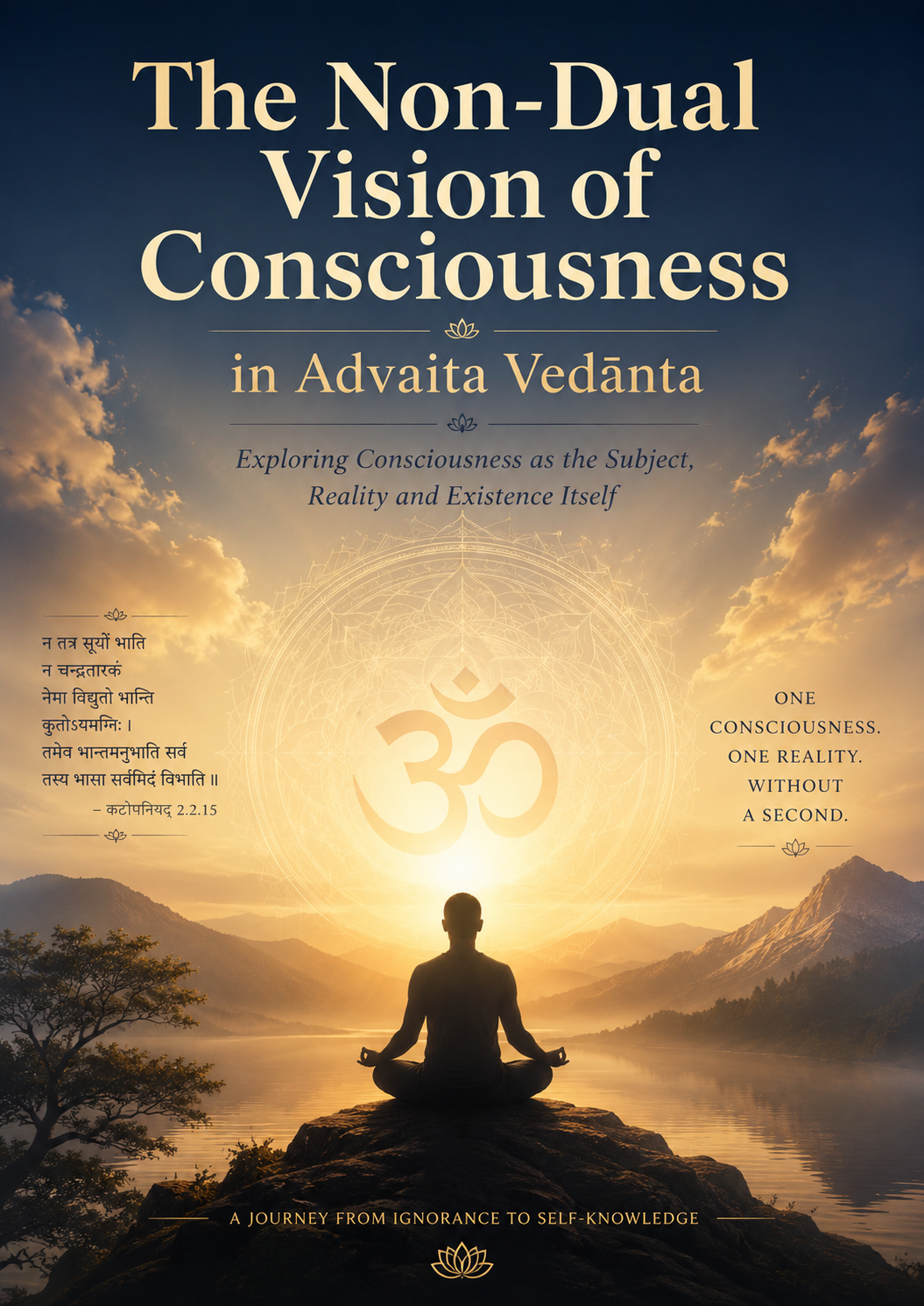
📌The non dual vision of consciousness in advaita vedanta - An Essay
This essay presents the Advaita Vedānta view that consciousness is not a product of the brain or body, but the fundamental, limitless reality underlying all experience and existence. Through logical inquiry into the subject-object relationship, the three states of experience, and the nature of creation, it argues that the individual self and the universal reality are one non-dual consciousness.
📌Śrī Lalitā Sahasranāma Stotram — Complete Commentary in 20 Parts
The complete Śrī Lalitā Sahasranāma — one thousand names of the Divine Mother — with a full commentary exploring Vedānta philosophy, Śrī Vidyā tradition, and the inner journey of awakening. A sacred text from the Brahmāṇḍa Purāṇa, presented in 20 articles.
An Introduction to Vedic Astrology — The Science of Light
Jyotish — the Eye of the Vedas — is not mere fortune-telling. It is the most precise system of self-knowledge ever devised, mapping the soul's karmic blueprint through the language of the cosmos.

Healing Crystals in the Vedic Tradition — Ratna Shastra
The Vedic science of gemstones — Ratna Shastra — prescribes specific stones to strengthen beneficial planetary energies and pacify malefic ones, acting as cosmic antennae tuned to specific frequencies.

Om Namah Shivaya — The Mahamantra of Liberation
Of all the mantras in the vast ocean of Vedic tradition, Om Namah Shivaya stands apart — not merely as a prayer to Shiva, but as a direct map of consciousness itself encoded in five sacred syllables.

Advaita Vedanta — The Teaching of Non-Dual Consciousness
The crown jewel of Indian philosophy, Advaita Vedanta as crystallised by Adi Shankaracharya declares one radical truth: there is only Brahman — pure, undivided, self-luminous consciousness.
Understanding Anxiety Through the Lens of Vedic Psychology
You are lying in bed at 2 AM. Your body is safe. The room is quiet. Nothing is happening. And yet your chest is tight, your mind is racing, and a wordless dread saturates your entire being — a conviction that something is wrong, or about to go wrong,...
Is Consciousness Produced by the Brain? The Question Science Cannot Escape
There is an assumption so deeply embedded in modern culture that most people do not even recognize it as an assumption. It goes like this: consciousness is something the brain does. Neurons fire, chemicals flow, electrical patterns dance across the c...
The Science and Spirit of Healing Crystals — How Gemstones Actually Work
People have worn gemstones for as long as there have been people. Long before anyone understood crystallography or mineralogy, human beings were drawn to certain stones with an instinct that went deeper than aesthetics. They ground them into powders ...
Tarot vs Intuition — Do the Cards Know Something, or Do You?
There is a question that every Tarot reader — beginner and veteran alike — eventually confronts: where is the insight actually coming from? Is it the cards? Is it the reader's intuition? Is it something else entirely — a spiritual intelligence, a cos...
What is Advaita Vedānta? The Philosophy That Says You Were Never Separate
There is a question that has troubled human beings for as long as we have had the capacity to wonder: Who am I? Not your name, not your profession, not the roles you play in the world — but the raw, unadorned you that remains when everything else is ...
What is Jyotisha? The Sacred Science of Light That Goes Far Beyond Prediction
There is a version of Vedic astrology that circulates in the popular imagination: a system of prediction, a cosmic fortune-telling device that tells you when you will get married, whether you will be wealthy, and which planetary period to fear. This ...
Why Your Gemstone Isn't Working — Seven Reasons Remedial Stones Fail
You did everything right — or so you thought. You consulted an astrologer. You bought the gemstone. You had it set in the prescribed metal, wore it on the correct finger, on the correct day, during the correct Nakṣatra. You even chanted the mantra. W...
Attachment and Relationships — What the Gītā Really Teaches About Love
"Be detached." This is perhaps the most frequently cited — and most frequently misunderstood — piece of spiritual advice in the Indian tradition. It is offered as a remedy for relationship pain, for heartbreak, for the inevitable suffering that comes...
Can Tarot Predict the Future? An Honest Answer
This is the question everyone asks and nobody answers well. Most Tarot practitioners either oversell ("Yes, the cards can see your future") or undersell ("No, Tarot is only about self-reflection"). The truth is more interesting than either.
Choosing Your Gemstone — A Practitioner's Guide Rooted in Jyotisha and Tradition
Walk into any gemstone shop today and you will be surrounded by beauty. Amethyst cathedrals catching the light. Rows of polished tumble stones in every colour imaginable. Rose quartz hearts, obsidian mirrors, citrine towers. You will also, almost cer...
Death in Advaita Vedānta — What Actually Happens When the Body Falls?
Death is the one experience that every human being knows is coming and almost no one is willing to think about clearly. We push it to the periphery of consciousness, building our lives as if we have unlimited time, reacting with shock when death touc...
Karma and Free Will in Jyotisha — Are You Living a Script or Writing One?
This question has haunted every sincere student of Jyotisha. If a birth chart can describe the broad contours of a person's life — their temperament, their health vulnerabilities, their relationship patterns, the timing of major events — then where i...
Māyā: The Grand Veiling — Why Reality Hides in Plain Sight
If Brahman is the only reality — infinite, undivided, unchanging — then how do we explain this? This world of staggering diversity, of birth and death, of mountains and rivers, of love and heartbreak? If there is only one thing, why does everything l...
The Navagraha — Nine Cosmic Forces That Shape Every Human Life
When the Vedic sages looked at the sky, they did not see lifeless rocks orbiting a star. They saw a living system — a cosmic government, if you will — in which nine great forces administered the unfolding of karma across all planes of existence. They...
Emotional Exhaustion and Tamas — When the Mind Goes Dark and How to Find Your Way Back
There comes a point — and if you are reading this article, you may know it well — when you are not sad, exactly, and not angry, and not anxious, but simply done. Empty. Heavy. A thick fog has settled over everything, draining the colour from activiti...
The Ethics of Tarot Reading — What Every Reader and Querent Should Know
A woman sits across from you. She is anxious, her hands fidgeting in her lap. She has come to you because her marriage is in trouble, because she has received a frightening medical diagnosis, because she has lost her sense of direction and is graspin...
Tat Tvam Asi — The Four Great Sayings That Shatter the Illusion of Separation
Scattered across the Upaniṣads are four sentences — just four — that contain, in compressed form, the entire teaching of Advaita Vedānta. They are called the Mahāvākyas, the "great sayings," and each one comes from a different Veda. Together, they co...
The Twelve Bhāvas — How a Birth Chart Maps the Architecture of Your Entire Life
Imagine a building with twelve rooms. Each room is dedicated to a specific department of life — one for your health, one for your wealth, one for your relationships, one for your career, and so on. Now imagine that at the moment of your birth, the pl...
Why Astrological Predictions Fail — An Honest Examination
Let us be direct about something that the astrological community rarely discusses openly: predictions fail. They fail often. They fail even when made by experienced and well-intentioned astrologers using classical methods. And understanding why they ...
Why You Still Feel Empty After Getting Everything You Wanted
You worked for years. You got the promotion, the house, the relationship, the recognition. By every external measure, your life is working. People envy your position. Your family is proud. Your bank account confirms your competence.
Ego vs Ahaṃkāra — Why the Western and Vedic Concepts Are Not the Same Thing
Open any modern spiritual book and you will find the ego cast as the villain. "Dissolve the ego." "The ego is the obstacle." "Enlightenment is the death of the ego." The word has become spiritual shorthand for everything that keeps you from liberatio...
Nakṣatras — The 27 Lunar Mansions and the Hidden Layer of Vedic Astrology
Most people who encounter Jyotisha for the first time learn about the twelve Rāśis (signs) and the nine Grahas (planets). They learn that they are a "Meṣa Lagna" or that their Moon is in Vṛścika. This is useful, but it is like learning that someone l...
Saturn Transit Effects Explained Rationally — Beyond Fear, Toward Understanding
No planet inspires more dread than Saturn. The moment someone learns they are entering Sāḍe Sātī or that Saturn is transiting a sensitive point in their chart, a wave of anxiety sweeps through. Social media amplifies this — every year brings a new ro...
Spiritual Bypassing — When Wisdom Becomes a Weapon Against Yourself
He had read all the right books. He could quote the Gītā, discuss Māyā with fluency, and explain the nature of the Ātman with impressive clarity. When his marriage fell apart, he said, "The Ātman is unaffected by relationships — this is just the play...
Waking, Dreaming, Deep Sleep — What the Three States of Consciousness Reveal About You
Every single day, without exception, you pass through three radically different states of existence. In the morning you wake into a world of solid objects and other people. At night you enter a world constructed entirely by your own mind, indistingui...
The Daśā System — How Karma Unfolds on a Cosmic Timetable
A birth chart is a photograph. It captures the sky at a single instant and freezes it. But life is not a photograph — it is a film. Things change. Fortunes rise and fall. Relationships form and dissolve. Health fluctuates. What was impossible at twen...
Maṅglik Doṣa — Separating Fact from Fear in the Most Misunderstood Concept in Jyotisha
Few concepts in Jyotisha have caused as much unnecessary anxiety, broken as many promising engagements, or generated as much commercial exploitation as Maṅglik Doṣa. Families have refused excellent matches on the basis of this single factor. Young pe...
Viveka and Vairāgya — The Inner Preparation Without Which No Truth Can Land
There is a common fantasy in spiritual circles: that enlightenment can arrive like a thunderbolt, without preparation, without effort, without the slow and sometimes unglamorous work of inner readiness. A person reads a book, hears a talk, has a sudd...
Witness Consciousness Explained Simply — The Most Important Idea You Will Ever Encounter
Right now, as you read these words, something is happening that is so obvious, so intimate, so constantly present that you have probably never noticed it: you are aware.
Lalitā Sahasranāma Part 1: The Meditation Verses and the Birth of the Goddess
The series begins. First come the meditation verses that paint the Mother in the mind. Then her story opens: she rises from the fire of pure awareness to help the gods, and her beauty is described from the crown downward. Red means love and…
Lalitā Sahasranāma Part 2: Her Court, the War on the Ego, and the Mantra-Body
Her portrait is completed, and she is given a home, a court, and an army. Then the great battle begins against the demon who stands for the stubborn ego. Near its end this installment turns inward, to the secret that her very body is sacred sound.
Lalitā Sahasranāma Part 3: The Rising Inner Power and the Great Negation
The coiled inner power rises through the centres of the body to meet Śiva at the crown. Then a turning point arrives — the “Great Negation.” A long chain of names begins to say what she is not, clearing away every false idea so the truth can stand.
Lalitā Sahasranāma Part 4: Beyond All Forms, and the Return to Fullness
The negations continue, then soften into grace. She is beyond every form, and yet she leans toward those who love her. The same Reality that has no shape wears a mother’s face for our sake.
Lalitā Sahasranāma Part 5: The Supreme Beauty and the Five Cosmic Acts
From emptiness, fullness returns. After saying what she is not, the hymn says what she is — everything. She is crowned as the supreme Beauty, and her five cosmic acts are named: creating, keeping, dissolving, hiding, and blessing.
Lalitā Sahasranāma Part 6: Her Cosmic Body — the Universe as the Mother
Her court, and her cosmic body. The worlds are shown to be her limbs, and the whole universe her visible form. The universe is not outside God; it is God made visible.
Lalitā Sahasranāma Part 7: The Sound Behind All Names, and the Sweetness of the Goddess
She is the sound behind every name, and then the hymn fills with sweetness — honey, nectar, delight. Desire itself appears, now purified and offered upward. Joy, rightly seen, is a face of the Divine.
Lalitā Sahasranāma Part 8: She Who Loosens Bonds — “That Thou Art”
She is the one who loosens our bonds. The great sentence “That Thou Art” is sounded: you are not separate from the Highest. The four levels of speech are taught, from the silent source to the spoken word.
Lalitā Sahasranāma Part 9: Beyond Mind and Speech — Awareness and the Inert
Beyond mind and beyond speech. Words point at her and fall back. The hymn carefully separates the awareness that sees from the matter that is seen — and she is the awareness.
Lalitā Sahasranāma Part 10: The Centres of the Body (I) — Ascending the Inner Temple
A guided tour through the centres of the body begins. At each centre lives a goddess-power with her own colour and gifts. The body is a temple of many floors, and the Mother lives on every floor.
Lalitā Sahasranāma Part 11: The Centres of the Body (II) and the Mirror of Pure Knowledge
The tour through the inner centres continues, and then the hymn turns to the pure mirror in which awareness sees itself. Knowledge here is not information; it is the Self knowing the Self.
Lalitā Sahasranāma Part 12: The Pure Mirror and the Cave of the Heart
The pure mirror, and then the cave of the heart. The Highest dwells in the small space inside the heart — and that space is wider than the sky. Do not search far; the Infinite hides at the centre of your own chest.
Lalitā Sahasranāma Part 13: The One Without a Second — the Great Triads
The One without a second. The great triads of the world are named and then gathered back into unity. Everything that seems to be three is, at its root, one.
Lalitā Sahasranāma Part 14: Royal Refuge and the Teacher Who Teaches in Silence
Royal refuge, and the teacher who teaches in silence. She shelters all who come to her. She is also the young guru whose deepest teaching needs no words; the world rests on her as a dream rests on the dreamer.
Lalitā Sahasranāma Part 15: The Healing Names — Nectar on the Fire of Life
The healing names — some of the most beloved in the hymn. She is rain of nectar on the forest-fire of worldly life, and sunrise on the darkness of old age. The power that heals is the power that awakens.
Lalitā Sahasranāma Part 16: The Fierce Forms and the Self Within
The fierce forms, and the Self within. She is the cosmos outside and the awareness inside — and these are not two. What looks terrifying is the same love, clearing the way.
Lalitā Sahasranāma Part 17: The Taste of Bliss and the Inner Controller
The deep taste of joy, and the Inner Controller. She sits inside every being, guiding from within, and her hand turns the wheel of birth and death. The One who turns the wheel can also stop it for you.
Lalitā Sahasranāma Part 18: Rest for the Weary, and the Unborn
Rest for the weary. She gives rest to all who are scorched by birth, age, and death. She is the Unborn — never made, never destroyed — and the still centre of all change. Peace is not built; it is uncovered.
Lalitā Sahasranāma Part 19: Actionlessness and the Priceless State of Freedom
Action without bondage. She is stillness itself, even in the midst of all doing, and she gives the priceless state of perfect freedom. The wise act, but the Self in them never moves.
Lalitā Sahasranāma Part 20: The Summit — the Union of Śiva and Śakti
The summit, and the close. She is beyond the worlds and beyond all qualities, yet known even to children. She is the lamp that ends the darkness of ignorance. The hymn ends in the union of Śiva and Śakti, and the final name, Lalitāmbikā — the…
The Vault Is Always Growing
Articles are published regularly across all categories. Follow us to receive new wisdom directly.
Get in Touch