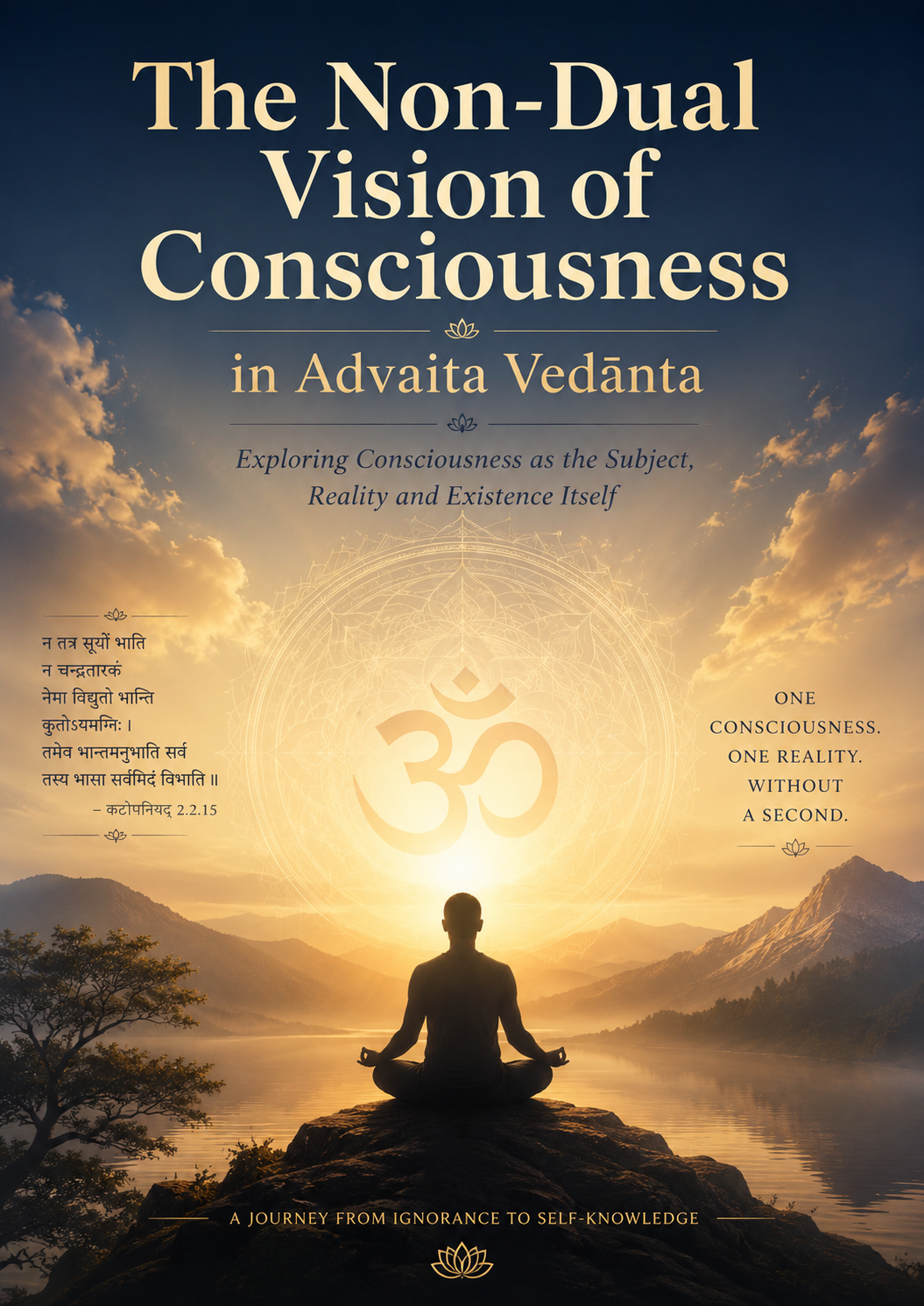
There is a question that has troubled human beings for as long as we have had the capacity to wonder: Who am I? Not your name, not your profession, not the roles you play in the world — but the raw, unadorned you that remains when everything else is stripped away.
Advaita Vedānta offers the most radical answer ever proposed in the history of human thought. It says: You are not what you think you are. You are not even a part of something larger. You are the whole. The entire universe, the totality of existence, the ground of all being — that is what you are. There is nothing else.
The word "Advaita" means "not two." Not "one" in the sense of a single object sitting in empty space. "Not two" — meaning there is no second thing. No separation. No gap between you and the cosmos. What appears as multiplicity — this tree, that mountain, you reading these words, me writing them — is a single, undivided reality appearing as many.
This is not a poetic metaphor. For the Advaitin, this is the most precise description of what actually is.
The Roots: Where Did This Come From?
Advaita Vedānta belongs to the broader tradition of Vedānta, which literally means "the end of the Vedas." The Vedas are the oldest scriptures of the Indian tradition — vast collections of hymns, rituals, and philosophical inquiry that stretch back thousands of years. Vedānta concerns itself with the final, culminating teachings of these texts, particularly the Upaniṣads.
The Upaniṣads are extraordinary documents. Written in a time before philosophy had become an academic discipline, they read less like textbooks and more like records of direct encounter — sages sitting with students under trees, by rivers, in the stillness of dawn, asking the most fundamental questions and arriving at answers that still shake the foundations of how we understand reality.
It was Ādi Śaṅkarācārya, the brilliant 8th-century philosopher-monk, who systematized the Advaitic interpretation of these teachings into a coherent philosophical framework. Śaṅkara did not invent Advaita — the insights were already present in the Upaniṣads, in the Brahma Sūtras, and in the Bhagavad Gītā. What he did was argue, with devastating logical precision, that non-duality was the only consistent reading of these texts, and the only position that could withstand rigorous philosophical scrutiny.
The Core Teaching: Brahman Alone Is Real
At the heart of Advaita Vedānta are three propositions, often summarized in a single Sanskrit phrase attributed to Śaṅkara:
Brahma satyam, jagan mithyā, jīvo brahmaiva nāparaḥ.
Brahman is real. The world is mithyā. The Jīva is Brahman itself, nothing else.
Let us take each part slowly.
Brahman is real (Brahma satyam). Brahman is the term used for the absolute, infinite, unchanging reality. It is not a god sitting in some heaven. It is not a person. It is pure existence, pure consciousness, pure limitlessness — Sat-Chit-Ānanda. Brahman is what remains when every transient appearance has come and gone. It is the ground in which all experience arises, plays out, and dissolves — while it itself never changes.
Think of it this way. You have been through thousands of experiences in your life. Joy, grief, boredom, excitement, deep sleep, vivid dreams. Every single one of those experiences has come and gone. But the awareness in which they appeared — has that ever changed? Has consciousness itself ever been absent from your experience? Even in deep sleep, when you wake up you say "I slept well" — meaning something was present even then, something that knew the absence of everything else. That ever-present awareness, that unchanging witness, is what Vedānta points to as Brahman.
The world is mithyā (jagan mithyā). This is the most misunderstood part of Advaita, and it deserves careful attention. Mithyā does not mean "illusion" in the sense that the world is a hallucination or does not exist. If you stub your toe on a rock, the pain is real enough in the moment.
Mithyā means something more subtle: the world does not have independent existence. It depends entirely on Brahman for its reality, the way a wave depends on the ocean. The wave is not "unreal" — you can surf it, it can knock you over. But it has no existence apart from water. Take away the water, and there is no wave. The wave is water appearing as a particular form. That is what mithyā means: dependent reality, borrowed existence.
Everything you see around you — every object, every person, every galaxy — is Brahman appearing in a particular name and form (nāma-rūpa). The names and forms are transient. The underlying reality is not.
The Jīva is Brahman (jīvo brahmaiva nāparaḥ). The Jīva — the individual, the person you take yourself to be — is not a fragment of Brahman, not a spark thrown off from some cosmic fire. The Jīva is Brahman, fully and completely, right now, without any modification.
This is the teaching that stops people in their tracks. If I am already Brahman — infinite, limitless, free — then why don't I experience myself that way? Why do I feel small, limited, anxious, mortal?
The Advaitin's answer is devastatingly simple: ignorance. Not stupidity, not moral failure, but a beginningless cognitive error called avidyā — a fundamental misapprehension in which the unlimited takes itself to be limited. Like a person who has forgotten their own name but hasn't actually lost it. Like a dreamer who is terrified by a tiger in their dream, not realizing that they themselves are the very consciousness generating the entire dream, tiger included.
The Method: How Does One "See" This?
If the problem is ignorance, the solution is knowledge — not intellectual knowledge alone, but a direct, unshakeable recognition of what you actually are. Vedānta calls this ātma-jñāna, Self-knowledge.
The traditional path involves three stages:
Śravaṇa — listening to the teachings from a qualified teacher (guru) who can unfold the meaning of the scriptures in a systematic way. This is not casual reading. It is a sustained, methodical exposure to the vision of Vedānta, where each teaching builds upon the last, and objections are addressed as they arise.
Manana — reflection. Once you have heard the teaching, you must make it your own through reasoning. Every doubt must be faced, every "but what about..." must be pursued until it resolves. Vedānta does not ask for blind faith. It invites — even demands — rigorous inquiry.
Nididhyāsana — contemplation or meditation on the truth that has been understood. This is where intellectual understanding becomes lived reality. The habitual tendency to identify with the body-mind is deeply ingrained. Even after clear understanding, old habits of thinking reassert themselves. Nididhyāsana is the sustained abiding in the truth until it becomes as natural and effortless as breathing.
Why Does This Matter Today?
You might ask: this is ancient philosophy — beautiful, perhaps, but what does it have to do with my life?
Everything.
The fundamental human problem — the sense of being incomplete, the feeling that something is missing, the restless pursuit of the next experience, the next achievement, the next relationship that will finally make us whole — all of it rests on a single assumption: that you are a limited, separate being in a vast and indifferent universe.
Advaita Vedānta challenges that assumption at its root. It says: you are already whole. You are already complete. Not after enlightenment, not after years of practice, not after death — right now. The wholeness you seek is not something to be gained. It is what you already are, temporarily overlooked.
This is not a belief to be adopted. It is an investigation to be undertaken. And it is the most consequential investigation a human being can engage in — because its conclusion, if genuinely arrived at, resolves the root cause of all psychological suffering.
The wave does not need to become the ocean. It only needs to recognize that it was never anything else.
This article is part of a series on Advaita Vedānta at Vedhian.com. The teachings presented here draw from the Upaniṣads, Brahma Sūtras, Bhagavad Gītā, and the works of Ādi Śaṅkarācārya.