ज्ञान
The Knowledge Vault
A living, ever-expanding sacred library — Vedic wisdom for the modern seeker. New articles added regularly.
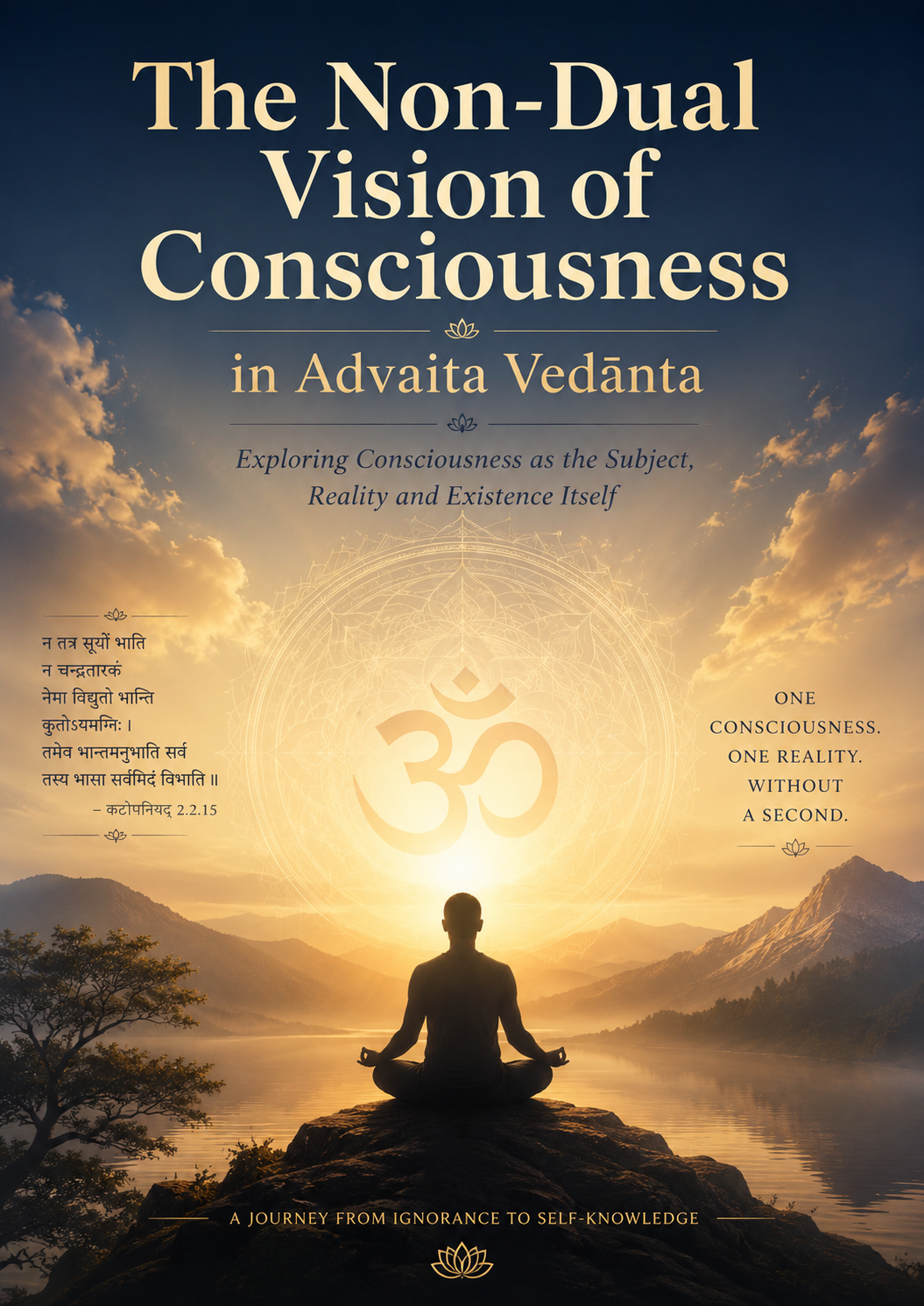
📌The non dual vision of consciousness in advaita vedanta - An Essay
This essay presents the Advaita Vedānta view that consciousness is not a product of the brain or body, but the fundamental, limitless reality underlying all experience and existence. Through logical inquiry into the subject-object relationship, the three states of experience, and the nature of creation, it argues that the individual self and the universal reality are one non-dual consciousness.
📌Śrī Lalitā Sahasranāma Stotram — Complete Commentary in 20 Parts
The complete Śrī Lalitā Sahasranāma — one thousand names of the Divine Mother — with a full commentary exploring Vedānta philosophy, Śrī Vidyā tradition, and the inner journey of awakening. A sacred text from the Brahmāṇḍa Purāṇa, presented in 20 articles.

Advaita Vedanta — The Teaching of Non-Dual Consciousness
The crown jewel of Indian philosophy, Advaita Vedanta as crystallised by Adi Shankaracharya declares one radical truth: there is only Brahman — pure, undivided, self-luminous consciousness.
Understanding Anxiety Through the Lens of Vedic Psychology
You are lying in bed at 2 AM. Your body is safe. The room is quiet. Nothing is happening. And yet your chest is tight, your mind is racing, and a wordless dread saturates your entire being — a conviction that something is wrong, or about to go wrong,...
What is Advaita Vedānta? The Philosophy That Says You Were Never Separate
There is a question that has troubled human beings for as long as we have had the capacity to wonder: Who am I? Not your name, not your profession, not the roles you play in the world — but the raw, unadorned you that remains when everything else is ...
What is Jyotisha? The Sacred Science of Light That Goes Far Beyond Prediction
There is a version of Vedic astrology that circulates in the popular imagination: a system of prediction, a cosmic fortune-telling device that tells you when you will get married, whether you will be wealthy, and which planetary period to fear. This ...
Attachment and Relationships — What the Gītā Really Teaches About Love
"Be detached." This is perhaps the most frequently cited — and most frequently misunderstood — piece of spiritual advice in the Indian tradition. It is offered as a remedy for relationship pain, for heartbreak, for the inevitable suffering that comes...
Māyā: The Grand Veiling — Why Reality Hides in Plain Sight
If Brahman is the only reality — infinite, undivided, unchanging — then how do we explain this? This world of staggering diversity, of birth and death, of mountains and rivers, of love and heartbreak? If there is only one thing, why does everything l...
Emotional Exhaustion and Tamas — When the Mind Goes Dark and How to Find Your Way Back
There comes a point — and if you are reading this article, you may know it well — when you are not sad, exactly, and not angry, and not anxious, but simply done. Empty. Heavy. A thick fog has settled over everything, draining the colour from activiti...
Tat Tvam Asi — The Four Great Sayings That Shatter the Illusion of Separation
Scattered across the Upaniṣads are four sentences — just four — that contain, in compressed form, the entire teaching of Advaita Vedānta. They are called the Mahāvākyas, the "great sayings," and each one comes from a different Veda. Together, they co...
Lalitā Sahasranāma Part 1: The Meditation Verses and the Birth of the Goddess
The series begins. First come the meditation verses that paint the Mother in the mind. Then her story opens: she rises from the fire of pure awareness to help the gods, and her beauty is described from the crown downward. Red means love and…
Lalitā Sahasranāma Part 2: Her Court, the War on the Ego, and the Mantra-Body
Her portrait is completed, and she is given a home, a court, and an army. Then the great battle begins against the demon who stands for the stubborn ego. Near its end this installment turns inward, to the secret that her very body is sacred sound.
Lalitā Sahasranāma Part 3: The Rising Inner Power and the Great Negation
The coiled inner power rises through the centres of the body to meet Śiva at the crown. Then a turning point arrives — the “Great Negation.” A long chain of names begins to say what she is not, clearing away every false idea so the truth can stand.
Lalitā Sahasranāma Part 4: Beyond All Forms, and the Return to Fullness
The negations continue, then soften into grace. She is beyond every form, and yet she leans toward those who love her. The same Reality that has no shape wears a mother’s face for our sake.
Lalitā Sahasranāma Part 5: The Supreme Beauty and the Five Cosmic Acts
From emptiness, fullness returns. After saying what she is not, the hymn says what she is — everything. She is crowned as the supreme Beauty, and her five cosmic acts are named: creating, keeping, dissolving, hiding, and blessing.
Lalitā Sahasranāma Part 6: Her Cosmic Body — the Universe as the Mother
Her court, and her cosmic body. The worlds are shown to be her limbs, and the whole universe her visible form. The universe is not outside God; it is God made visible.
Lalitā Sahasranāma Part 7: The Sound Behind All Names, and the Sweetness of the Goddess
She is the sound behind every name, and then the hymn fills with sweetness — honey, nectar, delight. Desire itself appears, now purified and offered upward. Joy, rightly seen, is a face of the Divine.
Lalitā Sahasranāma Part 8: She Who Loosens Bonds — “That Thou Art”
She is the one who loosens our bonds. The great sentence “That Thou Art” is sounded: you are not separate from the Highest. The four levels of speech are taught, from the silent source to the spoken word.
Lalitā Sahasranāma Part 9: Beyond Mind and Speech — Awareness and the Inert
Beyond mind and beyond speech. Words point at her and fall back. The hymn carefully separates the awareness that sees from the matter that is seen — and she is the awareness.
Lalitā Sahasranāma Part 10: The Centres of the Body (I) — Ascending the Inner Temple
A guided tour through the centres of the body begins. At each centre lives a goddess-power with her own colour and gifts. The body is a temple of many floors, and the Mother lives on every floor.
Lalitā Sahasranāma Part 11: The Centres of the Body (II) and the Mirror of Pure Knowledge
The tour through the inner centres continues, and then the hymn turns to the pure mirror in which awareness sees itself. Knowledge here is not information; it is the Self knowing the Self.
Lalitā Sahasranāma Part 12: The Pure Mirror and the Cave of the Heart
The pure mirror, and then the cave of the heart. The Highest dwells in the small space inside the heart — and that space is wider than the sky. Do not search far; the Infinite hides at the centre of your own chest.
Lalitā Sahasranāma Part 13: The One Without a Second — the Great Triads
The One without a second. The great triads of the world are named and then gathered back into unity. Everything that seems to be three is, at its root, one.
Lalitā Sahasranāma Part 14: Royal Refuge and the Teacher Who Teaches in Silence
Royal refuge, and the teacher who teaches in silence. She shelters all who come to her. She is also the young guru whose deepest teaching needs no words; the world rests on her as a dream rests on the dreamer.
Lalitā Sahasranāma Part 15: The Healing Names — Nectar on the Fire of Life
The healing names — some of the most beloved in the hymn. She is rain of nectar on the forest-fire of worldly life, and sunrise on the darkness of old age. The power that heals is the power that awakens.
Lalitā Sahasranāma Part 16: The Fierce Forms and the Self Within
The fierce forms, and the Self within. She is the cosmos outside and the awareness inside — and these are not two. What looks terrifying is the same love, clearing the way.
Lalitā Sahasranāma Part 17: The Taste of Bliss and the Inner Controller
The deep taste of joy, and the Inner Controller. She sits inside every being, guiding from within, and her hand turns the wheel of birth and death. The One who turns the wheel can also stop it for you.
Lalitā Sahasranāma Part 18: Rest for the Weary, and the Unborn
Rest for the weary. She gives rest to all who are scorched by birth, age, and death. She is the Unborn — never made, never destroyed — and the still centre of all change. Peace is not built; it is uncovered.
Lalitā Sahasranāma Part 19: Actionlessness and the Priceless State of Freedom
Action without bondage. She is stillness itself, even in the midst of all doing, and she gives the priceless state of perfect freedom. The wise act, but the Self in them never moves.
Lalitā Sahasranāma Part 20: The Summit — the Union of Śiva and Śakti
The summit, and the close. She is beyond the worlds and beyond all qualities, yet known even to children. She is the lamp that ends the darkness of ignorance. The hymn ends in the union of Śiva and Śakti, and the final name, Lalitāmbikā — the…
The Vault Is Always Growing
Articles are published regularly across all categories. Follow us to receive new wisdom directly.
Get in Touch