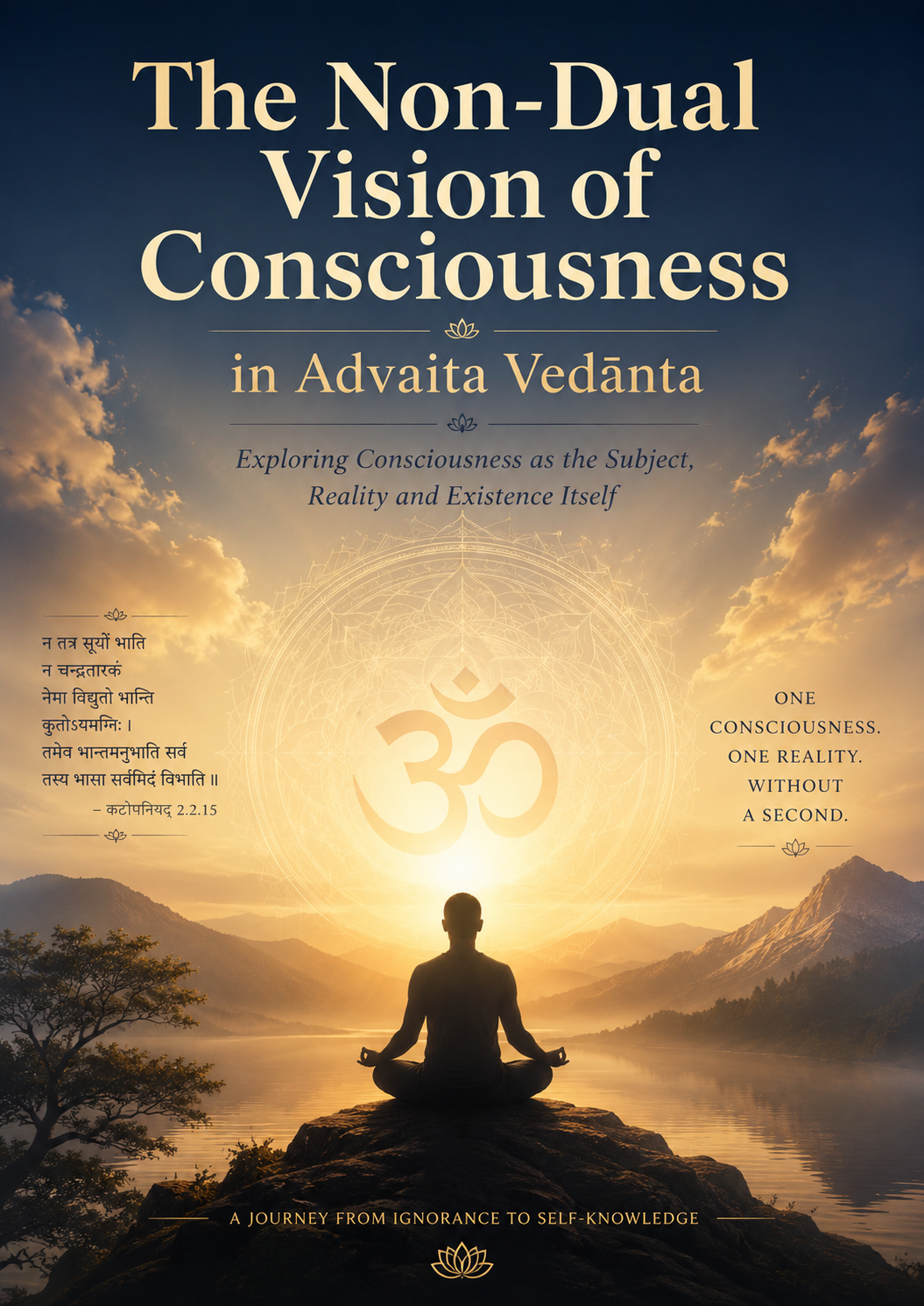
Every single day, without exception, you pass through three radically different states of existence. In the morning you wake into a world of solid objects and other people. At night you enter a world constructed entirely by your own mind, indistinguishable from reality while it lasts. And somewhere in between, you fall into a state so deep that the entire universe — inner and outer — vanishes completely, and yet you continue to exist.
Most of us pay no attention to this. We treat waking as "real life," dreaming as a curiosity, and deep sleep as mere unconsciousness. But the ancient sages of the Māṇḍūkya Upaniṣad — one of the shortest and most powerful texts in the entire Vedāntic tradition — looked at these three states with extraordinary care and arrived at a conclusion that overturns everything we ordinarily believe about who and what we are.
Their method was simple but devastating: if you can observe something, you cannot be that something. The seer is always other than the seen. And if you can observe all three states — if there is a "you" that is present across waking, dreaming, and deep sleep — then that "you" cannot be any of the three states. It must be something else entirely. Something that is always present but never itself an object of experience.
They called this Turīya — "the fourth." Not a fourth state, but the substrate, the awareness, the unchanging ground in which all three states appear and disappear.
The Waking State: Viśva
When you are awake, you experience the world through your five sense organs. You see colours, hear sounds, taste food, smell fragrances, feel textures. The world appears solid, external, shared with others, governed by consistent laws. This is the state we privilege above all others — we call it "reality" and measure everything else against it.
In the waking state, the Jīva is called Viśva — the one who experiences the gross, physical universe through the gross body (sthūla śarīra). The instruments available to Viśva are the five organs of perception (eyes, ears, nose, tongue, skin), the five organs of action (speech, hands, feet, excretory and reproductive organs), the five prāṇas (vital energies), and the mind (manas) together with the intellect (buddhi).
The waking state feels absolutely real while you are in it. The table you are sitting at seems unquestionably solid. The person across from you seems indisputably other. The passage of time seems self-evident.
But here is the first crack in the edifice: when you are dreaming, the dream world also feels absolutely real. The dream table is solid. The dream person is other. The dream time passes convincingly. You do not know you are dreaming while you are dreaming. The sense of "this is real" is present in both states with equal force.
So the feeling of reality is not, by itself, proof of reality. This is a disturbing observation, and the sages did not flinch from it.
The Dream State: Taijasa
In the dream state, the gross body is at rest. The sense organs are shut down. No external input is arriving. And yet — a complete world appears. Sometimes more vivid than waking life, sometimes bizarre and impossible, but always convincing while it lasts.
The dreamer is called Taijasa — "the luminous one" — because in the dream state, the Jīva is simultaneously the creator, the experiencer, and the entire universe of the dream. The light that illuminates the dream world is your own consciousness. The people, places, and events in the dream are all projections of your own mind. There is no "out there" in a dream — everything is "in here."
The instrument of the dream state is the subtle body (sūkṣma śarīra) — the mind, the intellect, the vital energies operating without the gross body. And the raw material of the dream is memory and impression (vāsanā) — the accumulated residue of past experiences, fears, desires, and tendencies, rearranged into novel combinations by the creative power of the mind.
Now, here is what makes the dream state so philosophically important for Vedānta: it demonstrates, beyond any theoretical argument, that your consciousness has the power to project an entire reality and then forget that it is doing so. In the dream, you take yourself to be one character within the dream, subject to the dream's events, at the mercy of its logic. You forget that the entire thing — every character, every landscape, every law of physics operating in that world — is your own projection.
The Advaitin asks: is it not possible that something similar is happening in the waking state? Not that the waking world is literally a dream, but that the sense of being a separate individual in an external world might itself be a kind of misidentification? That the consciousness which is producing the entire display might be taking itself to be just one small part of it?
Deep Sleep: Prājña
And then there is deep sleep — the state that most people dismiss as mere blankness, but which Vedānta treats as the most revealing of the three.
In deep sleep, the mind is completely resolved. There are no thoughts, no perceptions, no dreams, no sense of "I" or "other." The entire phenomenal world — gross and subtle — has vanished. And yet, upon waking, you do not report annihilation. You say, quite naturally, "I slept well" or "I slept peacefully." You say this with certainty, which means something was present during deep sleep that registered the experience — or rather, the quality — of that state.
The sleeper is called Prājña — "the one of knowledge" — and this name is significant. Even in the complete absence of objects, there is a knowing. Not knowing of something, but knowing as such. Pure awareness, without content, without division, without the subject-object split that characterises waking and dreaming.
In deep sleep, there is no suffering. No anxiety, no regret, no longing. The Jīva, temporarily relieved of the burden of individual identity, rests in what the Upaniṣad calls ānandamaya — the sheath of bliss. This is not the bliss of pleasure (which requires an object) but the bliss of wholeness, of the absence of limitation, of consciousness resting in its own nature.
But there is a catch: in deep sleep, this bliss is not recognized. It is experienced but not known as such, because the instrument of knowing — the mind — is dormant. Upon waking, the individual reconstitutes and immediately begins the familiar cycle of desire and aversion, having failed to bring back the one insight that could have ended the cycle forever: that the peace of deep sleep is not an absence but a presence — the presence of one's own true nature.
Turīya: The Fourth That Was Always First
Having analysed the three states, the Māṇḍūkya Upaniṣad then makes its decisive move. It points to Turīya — not a state alongside the other three, but the awareness that is equally present in all three.
In waking, awareness is present — but mixed with the perception of external objects. In dreaming, awareness is present — but mixed with the projection of internal images. In deep sleep, awareness is present — but without any content, known only by inference upon waking.
Turīya is awareness itself, stripped of all mixture. Not awareness of something. Not even awareness of nothing. Just awareness. The pure subject that can never become an object. The light by which all three states are known, which is itself never known as an object because it is the very principle of knowing.
The Māṇḍūkya describes Turīya through a series of negations, each one removing a possible misconception:
It is not inward-turned (it is not a subjective experience). It is not outward-turned (it is not an objective experience). It is not both (it is not a combination of subject and object). It is not a mass of knowing (it is not an aggregate). It is not knowing (it is not an activity). It is not unknowing (it is not inert). It is unseen, unrelated, ungraspable, without distinguishing marks, unthinkable, unnameable. It is the essence of the conviction of the oneness of the Ātman. It is the cessation of the world-appearance. It is peaceful, auspicious, non-dual.
This is not mystical obscurantism. It is precision. The sages are saying: Turīya cannot be described in positive terms because every positive description would make it an object — and it is precisely that which is never an object. It is the eye that cannot see itself, the hand that cannot grasp itself, the foundation that cannot be stood upon because everything is already standing on it.
Why This Analysis Matters
The three-state analysis is not an abstract philosophical exercise. It is a practical tool for self-knowledge. Here is how it works:
When you say "I am unhappy," you are identifying with a state — a mental condition that has arisen in the waking state. But that same "unhappy I" was completely absent in deep sleep. It was not that you were unhappy and asleep; the unhappy self literally did not exist. It arose when you woke up, along with the mind, the body, and the world. It is a product of the waking state, not your essential nature.
The same applies to every limitation you attribute to yourself. "I am old." Were you old in your dream last night? "I am a failure." Were you a failure in deep sleep? "I am mortal." Were you mortal in the gap between two thoughts?
Everything you fear about yourself — every inadequacy, every limitation, every mortality — belongs to the states. It belongs to the costumes you wear, not to you. The "you" that is present in all three states, unchanged, undamaged, undiminished, is Turīya. And Turīya, as the Upaniṣad declares with absolute finality, is Brahman.
This is not a matter of belief. It is a matter of observation. You can verify it tonight when you go to sleep. The person you take yourself to be will dissolve into nothing — and yet, tomorrow morning, you will wake up and report that you existed through the night. Something was continuous. Something persisted. That something is not the body, not the mind, not the personality. It is awareness itself.
And awareness, according to the Māṇḍūkya, is all there is.
The Om Connection
The Māṇḍūkya Upaniṣad opens with the statement that Om (Praṇava) encompasses everything — past, present, future, and that which transcends time. It then maps the three phonetic components of Om — A, U, M — onto the three states of consciousness.
"A" corresponds to Viśva, the waking state. "U" corresponds to Taijasa, the dream state. "M" corresponds to Prājña, deep sleep. And the silence that follows the sounding of Om — the pregnant stillness from which the sound arose and into which it returns — corresponds to Turīya.
This is not a symbolic convenience. It is pointing to something experiential. When you chant Om and let the sound dissolve into silence, you are enacting, in miniature, the return of all manifestation to its source. The silence is not the absence of sound; it is the fullness from which sound arises. Similarly, Turīya is not the absence of the three states; it is the fullness in which they appear.
Every time you complete the sound of Om, you touch, for an instant, the silence that is your own true nature.
This article is part of a series on Advaita Vedānta at Vedhian.com. The analysis of the three states is primarily drawn from the Māṇḍūkya Upaniṣad and Gauḍapāda's Kārikā, with reference to Śaṅkara's Bhāṣya on the same.